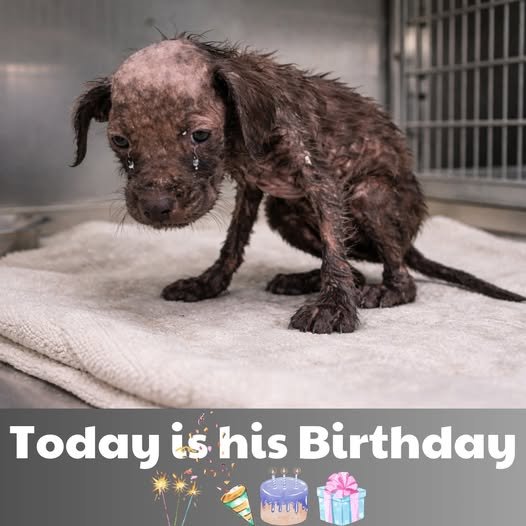
His First Birthday Should Have Been Joyful. Instead, He Spent It Learning That Love Can Hurt
The Birthday That Almost Wasn’t
The party hat keeps sliding over his ears, but Lak doesn’t seem to mind.
He sits patiently at the center of a small celebration in his foster home in Springfield, Missouri. A dog-safe cake sits before him, topped with peanut butter frosting and a single candle shaped like a bone. Streamers hang from the kitchen cabinets. Three other rescue dogs wear matching bandanas, waiting for permission to help destroy the cake.
Lisa, his foster mom, kneels beside him with her phone, trying to capture the perfect photo. But Lak won’t look at the camera. He keeps looking at Lisa. Always at Lisa. With those same eyes that once watched the world from a careful distance.
“One year ago today,” Lisa whispers. “One year ago, you arrived here not knowing if love was safe.”
Lak’s tail moves slowly. Not a wag, exactly. Just an acknowledgment. I remember.
The Beginning That Wasn’t a Beginning
Let me take you back to where Lak’s story really started.
Not on this happy day with cake and streamers. Not in this warm kitchen with people who adore him. But in a place where love was a foreign language and safety was something other puppies got.
Lak was born in a rundown trailer outside Springfield, Missouri. His mother belonged to someone who didn’t believe in vet care or proper food or warmth for animals. She was kept for reasons no one quite understood — maybe to breed, maybe just because she’d always been there.
When Lak and his siblings arrived, they were an inconvenience. Something else to feed. Something else to ignore.
The first weeks of Lak’s life were not filled with gentle hands and soft voices. They were filled with hunger, with cold, with the confusing absence of the comfort every newborn should know. His mother tried her best, but she had nothing to give. She was starving too.
While other puppies in other homes were tumbling over littermates, chasing toys, learning that humans meant happiness, Lak was learning something else entirely.
He was learning that the world was unpredictable. That warmth was temporary. That crying for help changed nothing.
The Eyes That Told Everything
By the time Lak was four weeks old, the differences were visible.
His body was small — smaller than it should have been. His head seemed slightly too large for his frame, a delicate thing that he held carefully, as if even the weight of his own skull was exhausting. His fur was dull, his ribs visible beneath a thin coat.
But it was his eyes that stopped people.
They were dark, deep, and they held a distance that no puppy should possess. When humans approached, he didn’t wiggle toward them like his siblings. He didn’t wag his tail. He didn’t make puppy sounds of excitement.
He watched. From a distance. From behind his mother. From the corner of the box they all lived in.
He was learning the most important lesson of his young life: humans were not safe.
The Day Everything Changed
When Lak was six weeks old, someone finally called.
A neighbor had noticed the dogs. Had noticed the conditions. Had noticed that the puppies, now weaned, were starting to look desperate.
Animal control came. The owner surrendered the dogs without argument — relieved, probably, to be rid of the responsibility.
Lak and his siblings were taken to a shelter in Springfield. His mother went somewhere else, to a different facility with space for larger dogs.
Lak never saw her again.
At the shelter, his siblings adapted. They were young enough, resilient enough, to bounce back. They wagged at volunteers. They competed for attention. Within weeks, most of them were adopted.
Lak was not adopted.
Lak hid in the back of his kennel, watching the world pass by. Watching families stop at other kennels. Watching other dogs leave. Watching, always watching, from that careful distance he’d perfected.
The Volunteer Who Saw Him
Maria had been volunteering at the shelter for two years. She’d seen hundreds of dogs. She thought she’d seen every type.
Then she met Lak.
She was doing evening kennel checks when she noticed him. A small puppy — barely more than a baby — curled in the far corner of his kennel, pressed against the wall as if trying to disappear into it. His eyes were open, watching her, but he made no sound. No movement. No invitation.
Maria knelt down. “Hey, little one.”
No response.
She opened the kennel door slowly. Sat down inside, not approaching, just being present. She pulled out her phone and scrolled through photos of her own dogs, talking softly about nothing important.
For twenty minutes, nothing happened.
Then Lak moved. Just slightly. Just enough to shift his position so he could see her better.
Maria kept talking. Kept being present. Kept proving that she wasn’t a threat.
After thirty minutes, Lak did something that made Maria’s heart crack open.
He crawled toward her. Slowly. Painfully slowly. Pausing every few inches to check if she was still safe. When he reached her leg, he pressed his tiny body against it and closed his eyes.
Just for a moment. Just long enough to breathe.
Maria didn’t move. Didn’t reach for him. Just let him be there, on his own terms, for the first time in his life choosing to be close to a human.
The Foster Promise
Maria called Lisa that night. “I found one. A special one. He needs you.”
Lisa had been fostering for years. She specialized in the broken ones, the scared ones, the ones who had given up on hope. She said yes before Maria finished describing him.
Lak came to Lisa’s house the next day.
For the first three days, he didn’t leave his crate. He’d eat when food was placed nearby. He’d use the puppy pads Lisa put out. Then he’d retreat to his safe space, curling into the smallest possible shape.
Lisa didn’t push. She just sat near the crate, reading aloud, letting him get used to her voice. Letting him learn that she wasn’t going anywhere.
On day four, he approached her while she was sitting on the floor. He stood a foot away, trembling, his eyes fixed on her face with that familiar question: Are you safe? Will you hurt me?
Lisa opened her hand, palm up. Lak leaned forward and pressed his nose against it. Then, slowly, he crawled into her lap and lay down.
He trembled for ten minutes before he relaxed. But he stayed.
The Slow Unfolding
Weeks passed. Months passed. Lak transformed, but not like other dogs.
His transformation wasn’t dramatic. It wasn’t the sudden burst of personality that shelters love to film. It was slow, incremental, almost invisible unless you were watching closely.
First came the tail wags. Not the wide, happy wags of normal dogs. Just small movements. Tentative. Testing whether joy was allowed.
Then came the toys. Lak discovered a stuffed hedgehog that squeaked. The first time he made it squeak, he froze, looked at it with alarm, then looked at Lisa as if to ask: Did I do something wrong?
Lisa laughed and clapped. Lak’s tail moved. He squeaked it again.
Then came the couch. Lak discovered that couches were soft. That lying on one was infinitely better than lying on the floor. That he could stretch out, legs in the air, and no one would hurt him for taking up space.
Lisa cried the first time she saw him do that. A dog who had once tried to be invisible now sprawled across her furniture like he owned it.
The First Birthday
Which brings us back to today.
The cake is demolished. Lak has peanut butter on his nose and a look of confused satisfaction on his face. The party hat is long gone, destroyed during a moment of unexpected zoomies that left everyone laughing.
Lisa finally got her photo. Lak, wearing the remains of the hat, looking at her with those impossible eyes — the same eyes that once watched the world from a careful distance.
Today, those eyes are asking if there’s more cake.
Lisa posts the photo with a caption: “One year ago, he arrived here not knowing if love was safe. Today, he’s celebrating his first birthday in a home where he’s loved unconditionally. Happy birthday, Lak. You are so brave. You are so loved.”
Within hours, the post is shared hundreds of times. Comments pour in — from people in Missouri, in Kansas, in Illinois. People who needed to see this today. People who needed to believe that even the most fragile spark can become a flame.
The Question We Must Answer
Lak’s story has a happy ending because one volunteer sat in a kennel for thirty minutes. One foster mom opened her home. One tiny puppy decided to risk trusting again.
But for every Lak, there are hundreds more still hiding in corners. Still watching from a distance. Still waiting to learn that love can be safe.
Here’s what you can do:
-
Share Lak’s story. Share it so that someone, somewhere, remembers to sit quietly with the scared ones.
-
Support rescue organizations in your area. They’re the ones who find the hidden ones, the frightened ones, the ones who’ve given up.
-
Consider fostering. Lak needed time to learn that love was safe. Foster homes make that possible.
-
Visit our website for more rescue stories. Every story is a reminder that even the smallest spark is worth fighting for.
Lak is home now. His first birthday was a celebration of survival, of trust, of second chances.
But somewhere, right now, another puppy is hiding in a corner, watching the world from a careful distance.
Be the one who sits down and waits. Be the one who proves that love is safe.