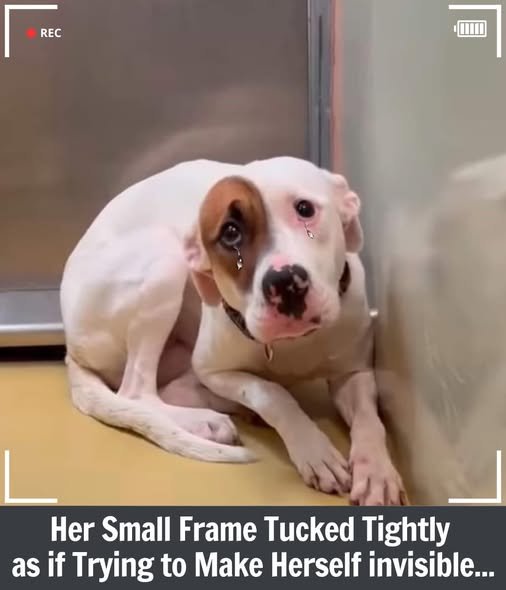
Her Small Frame Tucked Tightly, as if Trying to Make Herself Invisible: One Dog’s Journey from Fear to Trust
There is a specific kind of heartbreak that comes from seeing a living being try to disappear. It’s not the heartbreak of visible wounds or obvious suffering. It’s something quieter, deeper. It’s the sight of a small, matted creature curled into a impossibly tight ball in the corner of a dark shed, her head tucked so low that her nose touches her tail, her body tense, her eyes squeezed shut. She is not sleeping. She is not resting. She is bracing. Bracing for a world that has only ever hurt her. She has learned, through experiences we can only imagine, that the safest thing she can be is invisible. And so, when the door creaked open and light spilled into her darkness, she did not lift her head. She did not wag her tail. She simply tucked herself tighter, praying that if she made herself small enough, quiet enough, still enough, the danger would pass her by.
Her name, the rescuers would later decide, is Lily. It’s a name that suggests delicacy, beauty, and the potential to bloom. But on that day, in that shed, Lily was a long way from blooming. She was a tightly closed bud, protecting a fragile heart from a world that had proven itself unworthy of her trust.
The Discovery: A Ghost in the Shadows
The call came from a property owner who had inherited an old farmhouse and was clearing out the outbuildings. In the back of a shed that hadn’t been opened in years, behind rusted tools and broken furniture, he found her. He had no idea how long she had been there. Weeks? Months? She had survived on whatever she could find—maybe rodents, maybe nothing at all. When he opened the door, she didn’t move. She just lay there, tucked into herself, waiting.
He called a local rescue group, his voice shaky. “There’s a dog in here,” he said. “I think she’s alive, but… I don’t know. She won’t look at me.”
The rescue team arrived within the hour. They approached the shed slowly, speaking in soft voices. When they opened the door and saw Lily, the smallest of the volunteers gasped. Lily was little more than skin and bones, her coat matted with dirt and her own waste. She was curled so tightly that she looked like a small, discarded rug. But she was breathing. She was alive.
One of the volunteers knelt down, staying at a distance, not wanting to crowd her. She spoke in a gentle murmur, the kind of voice you use with a frightened child. “Hey, sweet girl. It’s okay. We’re not here to hurt you.”
Lily did not respond. She did not uncurl. She did not open her eyes. She just stayed in her tight ball, waiting for the threat to pass.
The Psychology of Invisibility
Why do animals try to make themselves invisible? It’s a survival mechanism, deeply ingrained. In the wild, prey animals freeze or hide to avoid predators. But for a domestic dog like Lily, this behavior is a sign of profound trauma. She has learned that being seen leads to pain. Perhaps a harsh word, a raised hand, or outright abuse. Perhaps she was simply ignored for so long that she forgot she existed at all.
Invisibility is a coping mechanism. It’s a way of saying, “If I don’t exist, I can’t be hurt.” But it’s also a prison. It cuts her off from the very thing she needs most: connection, safety, love.
The rescue team knew they couldn’t rush her. They couldn’t grab her, force her into a crate, or drag her out of the shed. That would only confirm her fear that humans were dangerous. They had to earn her trust, one tiny step at a time.
The First Breakthrough: A Treat and a Glance
For the first hour, the team simply sat in the doorway of the shed, talking softly among themselves, letting Lily get used to their presence. They didn’t look directly at her—direct eye contact can be threatening to a frightened animal. They looked at the ground, at each other, at anything but her.
After a while, one of them placed a small pile of stinky, irresistible treats just a few feet from Lily’s hiding spot. Then they moved back and waited.
Minutes passed. Lily did not move. The team waited longer. They talked quietly, occasionally glancing over. Finally, slowly, almost imperceptibly, Lily’s nose twitched. She smelled the treats. Her survival instincts warred with her fear. Food was scarce. Hunger was real. But fear was powerful.
Another long minute. Then, with agonizing slowness, Lily uncurled just enough to stretch her neck toward the treats. She snatched one, retreated back into her ball, and ate it in quick, terrified bites. It was the first time she had moved in hours.
It was a tiny victory. But it was a victory.
The Rescue: Gentle Hands and Soft Words
It took three more visits before Lily allowed herself to be touched. On the fourth day, a volunteer sat beside her for two hours, just letting her smell her hand, get used to her scent. Finally, Lily gave a tiny, tentative lick to the volunteer’s fingers. It was a question. “Are you safe?”
The volunteer answered by gently, slowly, placing a hand on Lily’s back. The dog flinched but did not move away. The hand stayed, soft and warm. Lily let out a breath she seemed to have been holding for years.
From there, the rescue progressed. A leash was gently looped around her neck. She was carried—she was too weak to walk far—to a waiting vehicle. For the first time in who knows how long, Lily left the shed. She left the darkness. She left the only world she had known.
The Healing: Learning to Be Seen
At the veterinary clinic, Lily was examined, treated for malnutrition and parasites, and given a warm, soft bed. She still curled into a tight ball when anyone entered the room. But now, sometimes, she would lift her head. She would watch. She was beginning to learn that not all humans were threats.
Her foster home was a quiet place with a patient woman who understood trauma. She gave Lily space. She never forced interaction. She let the dog come to her when she was ready. Days turned into weeks. Slowly, almost miraculously, Lily began to change.
She started meeting her foster mom at the door when she came home. She started wagging her tail—just a little—when she heard her name. She started sleeping on her side, stretched out, no longer curled into a protective ball. She was learning that she didn’t need to be invisible. She was allowed to exist. She was allowed to be seen.
The first time Lily voluntarily climbed onto the couch and rested her head on her foster mom’s lap, the woman cried. It was a moment of pure, unearned trust. A gift from a dog who had every reason to never trust again.
Lessons from Lily: The Fragility and Resilience of Trust
Lily’s story is a masterclass in the psychology of trauma and the power of patience.
1. Trauma Manifests in the Body: Lily’s tight, tucked posture was not a choice; it was a physical manifestation of her psychological wounds. She was literally trying to protect her vital organs, to make herself a smaller target. Healing must address both body and mind.
2. Patience is the Only Path: You cannot rush a traumatized animal. You cannot demand trust. You have to earn it, minute by minute, day by day. Lily’s rescuers succeeded because they respected her timeline, not their own.
3. Small Victories Are Monumental: A nose twitch. A single treat taken. A tentative lick. These are not small things; they are bridges built across chasms of fear. Celebrating these tiny steps is essential.
4. Love is a Language: Lily didn’t understand the words “you’re safe.” But she understood the gentle tone, the slow movements, the warm hand. Love, communicated consistently and without demand, is a language every creature understands.
A New Chapter: Lily Today
Today, Lily is almost unrecognizable. She lives in a quiet home with a retired couple who have endless patience and a deep love for senior dogs. She has a favorite spot on the couch, a collection of soft toys she carries around, and a daily routine that involves long, slow walks and plenty of treats.
She still startles at loud noises. She still prefers quiet spaces. But she no longer tries to disappear. When her humans come home, she greets them at the door, her whole body wiggling with joy. She seeks out their laps. She demands belly rubs. She is seen, every day, and she loves it.
The tight, tucked ball of fur in that dark shed feels like a different dog entirely. In a way, she was. That dog was surviving. This dog is living.
A Call to Action: See the Invisible
Lily was lucky. Someone found her. Someone had the patience to sit in a dirty shed for hours, waiting for her to uncurl. But there are countless other Lilys out there—in sheds, in alleys, in the back of shelters, in the corners of yards. They are tucked tightly, trying to be invisible, waiting for someone to see them.
You can be that someone.
-
Look in the corners. When you visit a shelter, don’t just look at the dogs jumping and barking at the front of their kennels. Look at the ones in the back, the ones hiding, the ones who have given up on being chosen. They need you most.
-
Be patient. If you adopt a traumatized animal, understand that healing takes time. Don’t expect immediate gratitude or affection. Earn their trust slowly, and the reward will be immeasurable.
-
Support rescue organizations. Many animals like Lily require extensive veterinary care and long-term fostering before they are ready for adoption. Your donations make that possible.
-
Share their stories. Visibility is the first step toward salvation. Share stories of the invisible animals, and you increase the chances that someone will stop and see them.
Lily spent years trying to be invisible. Now, she glows. She is proof that no matter how tightly trauma tucks us in, love can help us unfold. She is proof that every creature deserves to be seen.