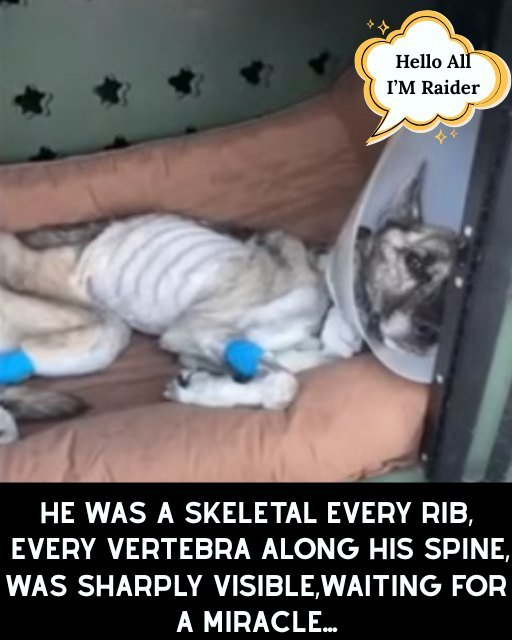
There are some images that stop you mid-scroll. Not because they are graphic, but because they are hauntingly quiet. The photograph of Raider is one of those images. When he was found, he wasn’t barking for help. He wasn’t wagging his tail. He was simply standing there—a fragile frame of bones draped in loose skin—waiting. Waiting for a miracle. Waiting for the pain to stop. Waiting for someone to prove that the world still had kindness in it.
At just 18 pounds, Raider was a living skeleton. Every rib was a ridge, every vertebra a sharp peak along his back. He was so weak that the act of standing seemed to require Herculean effort. In the silence of that moment, his life hung by a thread so thin it was almost invisible. This is the story of how we almost lost him to that silence, and the incredible fight that brought him back from the abyss.
The Anatomy of Neglect
When the rescue team first received the call about Raider, the description was vague: “An abandoned dog, looks very thin.” But no amount of preparation could brace them for the reality. Raider wasn’t just thin; he was a textbook case of starvation pushed to the absolute limit.
In the world of animal rescue, we see neglect, but Raider represented a level of suffering that defies logic. At 18 pounds, his body had long since exhausted its fat reserves. To keep his heart beating and his lungs breathing, his body had begun to consume its own muscle tissue. This is why his spine and ribs were so pronounced—there was literally nothing left between his skin and his skeleton.
But perhaps the most heartbreaking part wasn’t his physical state. It was his demeanor. Dogs who have been recently abandoned usually show signs of anxiety or fear. Dogs who have been lost usually show relief when a human approaches. Raider showed nothing. He had crossed the threshold from suffering into a state of emotional catatonia. He was a dog who had given up on the premise that humans meant anything good. He was waiting for a miracle, but he no longer believed it would come.
The First 24 Hours: A Race Against Time
The golden window for saving a starved animal is incredibly small. When a body has been deprived of nutrients for so long, the internal organs begin to shut down in a specific order. The biggest immediate danger is something called “refeeding syndrome.” It sounds counterintuitive, but giving too much food too quickly to a starving animal can kill them. Their body’s chemistry is so out of balance that a sudden influx of nutrients can cause catastrophic drops in phosphorus and potassium, leading to heart failure.
So, while the public might think the first step is to give Raider a giant steak, the medical team knew that his survival depended on patience. They started with small, bland, highly digestible meals—tiny portions administered every few hours. They wrapped him in warm blankets because a body with no fat cannot regulate its own temperature. They spoke to him in soft voices, not expecting a response, but hoping to penetrate the wall of trauma he had built around himself.
For the first two days, Raider didn’t move much. He would eat mechanically, as if he didn’t even taste the food. He would allow himself to be touched, but he didn’t lean into it. He was a ghost in a dog’s body, still hovering between this world and the next.
The Turning Point: The First Wag
It happened on the third night. A volunteer, let’s call her Sarah, was on overnight duty. She was sitting a few feet away from Raider’s kennel, reading a book out loud just to fill the silence of the shelter. She wasn’t reading to him specifically, just using him as a sounding board.
Midway through a paragraph, she heard a soft thump. She looked up. Raider had shifted his weight. His tail, a limp appendage for days, had lifted just an inch off the ground and tapped against the bedding. Thump. It wasn’t a wag of joy, not yet. It was a signal. It was a tiny, flickering light in the darkness saying, “I hear you. I’m still here.”
Sarah didn’t rush him. She simply continued reading, her own eyes filling with tears. That tiny thump was the first conversation Raider had initiated since arriving. It was the first sign that the dog inside that skeletal frame hadn’t died. He was just waiting for someone to call him back.
The Long Road to Recovery
Recovering from starvation isn’t just about the body; it’s about the mind. As Raider gained weight—slowly, steadily—his personality began to emerge. The dog who had been a blank slate started to show preferences. He liked the blue blanket more than the grey one. He preferred chicken-flavored food to beef. He didn’t like the sound of the coffee grinder in the morning.
Every pound he gained was a milestone. At 25 pounds, he stood a little taller. At 30 pounds, he took his first voluntary steps toward a volunteer. At 35 pounds, he discovered the joy of a squeaky toy. Watching him figure out how to play was like watching a child discover color for the first time. He was awkward, unsure, but undeniably curious.
The silence that once surrounded him was now filled with the sounds of life: the clatter of his food bowl, the padding of his paws on the floor, the soft “woofs” he would make when he wanted attention. The dog who was waiting to die was now living.
Lessons from Raider’s Resilience
Raider’s story, while extreme, holds a mirror up to our own lives. How many of us have been at 18 pounds emotionally? How many of us have felt so worn down by life that we just stood still, waiting for something—anything—to change?
-
Recovery is a Process, Not an Event: Raider didn’t get better overnight. It took weeks of tiny, consistent meals. In our lives, we often look for the big, dramatic fix. Raider teaches us that salvation is often found in the small, consistent acts of self-care and the patience we afford ourselves.
-
Connection Heals: The thing that pulled Raider back wasn’t just the food; it was the voice. It was the human connection offered without expectation. In a digital world, we often forget the power of simply “being there” for someone.
-
It’s Never Too Late: Raider was at death’s door. Medically, logically, he should have been a lost cause. But he proved that as long as there is a breath, there is a chance. It’s a powerful reminder that it’s never too late to turn your life around.
A Future Written in Paw Prints
Today, Raider is unrecognizable from the photo that sparked this story. He has filled out into a handsome, healthy dog with a shiny coat and eyes that sparkle with mischief. He has a foster home, and soon, he will have a forever home. He no longer waits for a miracle; he lives inside one.
But Raider’s story is not unique in its suffering, only in its survival. There are countless other animals—and people—waiting in silence for someone to see them. They are waiting for a voice to break through their darkness.
Raider’s life could have ended in silence, forgotten and alone. Instead, his story is being shouted from rooftops, a testament to the power of compassion. If Raider’s journey has touched your heart, don’t let the feeling end here. Share his story. Support your local shelters. And next time you see a “shadow” of a creature waiting for a miracle, remember that you have the power to be that miracle.
Because every Raider deserves a chance to wag again.