There are homes that feel peaceful.
And then there are homes that feel like time stopped inside them.
When the volunteer first stepped through the doorway, she noticed the silence. Not the kind of silence that feels restful — but the kind that presses against your ears.
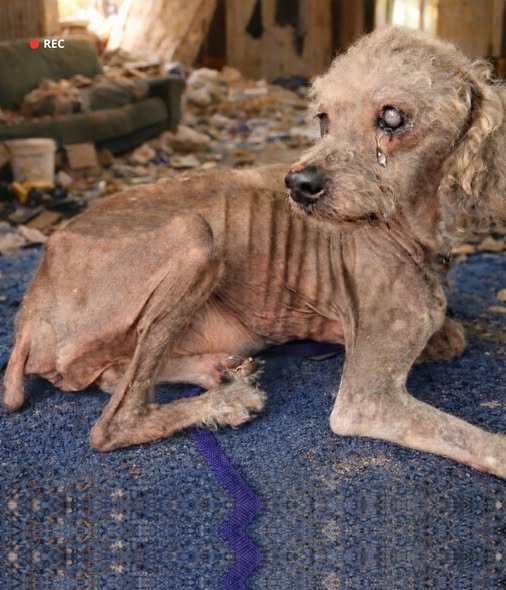
Dust hung in the air. The curtains were half drawn. An old green couch sagged in the corner of the room. Papers and small debris were scattered across the floor like no one had picked them up in weeks.
And on a worn blue carpet near the center of the room, Beni lay quietly.
He didn’t bark.
He didn’t lift himself fully.
He simply turned his head — slowly — as if even that required effort.
His body told the story before anyone spoke a word. His ribs stood out sharply against thinning skin. His hips looked fragile. His once-curly coat had dulled and thinned with neglect. One eye was clouded, and beneath it, a tear track had dried against his fur.
Beni was nine years old.
And he was fading.
A Home That Had Grown Too Still
Neighbors later explained that the house had belonged to an elderly man who lived alone.
He and Beni had been inseparable.
Morning walks.
Afternoon naps.
Evening television.
Then one day, the ambulance came.
And the house never felt alive again.
Family members had cleared out some belongings, but they hadn’t taken Beni immediately. There were conversations. Uncertainty. Plans that kept getting postponed.
Days passed.
Then weeks.
Someone came occasionally with food. But no one stayed long enough to notice the change.
No one stayed long enough to see Beni slowly disappearing.
What Happens When Dogs Grieve
Dogs are deeply bonded to routine and attachment figures. When their primary caregiver disappears, especially after years together, it can trigger something very real — canine depression.
Symptoms often include:
-
Loss of appetite
-
Withdrawal
-
Excessive sleeping
-
Reduced grooming
-
Physical decline
For senior dogs, the impact can be even more severe.
Beni wasn’t just physically neglected.
He was grieving.
He waited near the center of the room, close to where his owner’s chair once stood. As if proximity to memory might somehow bring him back.
The Moment Everything Shifted
It was a distant relative who finally contacted a local rescue.
They admitted they hadn’t realized how serious the situation had become.
The volunteer who arrived didn’t rush toward Beni. She knelt down several feet away and let him see her.
“Hi sweetheart,” she whispered.
Beni didn’t move at first.
Then, slowly — painfully slowly — his tail tapped the carpet once.
It was weak. But it was there.
That tiny movement told them something important.
He hadn’t given up yet.
Emergency Care
At the veterinary clinic, the diagnosis confirmed what was visible.
-
Severe malnutrition
-
Dehydration
-
Muscle wasting
-
Early kidney strain
-
Emotional trauma
But his heart was still strong.
Senior dog rescue cases require careful medical planning. Refeeding must be gradual. Hydration monitored closely. Stress minimized.
Beni was placed on:
-
Controlled nutritional therapy
-
IV fluids
-
Anti-inflammatory support
-
Gentle physical therapy
-
Constant human companionship
The first week was critical.
He slept often. He barely moved. But when someone sat beside him, he leaned into their touch.
He still trusted.
Despite everything.
The Quiet Transformation
Healing didn’t happen overnight.
It rarely does.
But small changes began appearing.
By week two:
He finished his meals.
By week three:
He stood without trembling.
By week four:
He walked toward the door when volunteers arrived.
And one morning, something extraordinary happened.
He picked up a toy.
It was an old plush rabbit someone had placed near his bed.
He carried it — carefully — across the room and laid down beside a volunteer.
It wasn’t play.
It was connection.
It was his way of saying, “I’m still here.”
Why Senior Dog Rescue Matters
Senior dogs like Beni are often overlooked in adoption systems. Many families want puppies or younger dogs.
But older dogs offer something different.
They offer:
-
Calm companionship
-
Established personalities
-
Deep gratitude
-
Gentle loyalty
And they deserve dignity in their final years.
According to animal welfare organizations, senior dogs are among the most at-risk for euthanasia in overcrowded shelters. Stories like Beni’s highlight why intervention matters — and how community awareness can literally save lives.
A New Beginning
Beni now lives in a foster home filled with soft blankets and quiet mornings.
He has a favorite sunspot near the window.
He eats slowly, but he eats.
He still moves gently — age doesn’t reverse — but there’s strength in his steps again.
Most importantly, the house is no longer too still.
There are voices.
There is laughter.
There are hands that don’t leave.
Lessons Beni Teaches Us
-
Grief is real — even for animals.
-
Senior pets need stability more than anything.
-
Silence can hide suffering.
-
Community action saves lives.
-
It’s never “too late” if someone chooses to step in.
Beni didn’t need grand gestures.
He needed someone to notice.
A Final Reflection
There was a time when Beni lay on that blue carpet in a house that felt forgotten.
He was fading.
Not loudly.
Not dramatically.
Just quietly.
And that’s what makes stories like his so powerful.
Because most suffering doesn’t shout.
It waits.
If Beni’s story moved you, consider supporting local animal rescue groups, fostering senior dogs, or simply checking in when something feels off in your neighborhood.
Sometimes, saving a life doesn’t require heroics.
Just attention.
And the courage to walk through a quiet door.