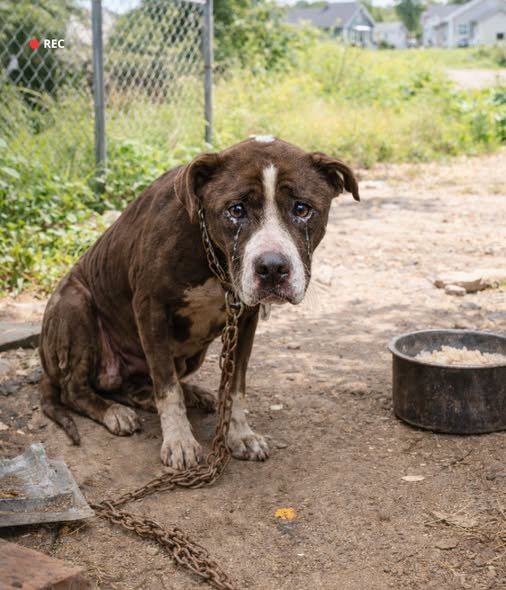
The day they left him behind, he didn’t understand what was happening.
He watched them walk away just like he had many times before, expecting that familiar moment when they would turn back, smile, and call his name.
But this time, they didn’t.
Instead, they fastened a thick metal chain around his neck and secured it to a post outside the house. The metal clinked heavily as it settled against the ground.
Then they left.
No goodbye.
No gentle pat on the head.
No explanation.
Just silence.
At first, the dog waited patiently. Dogs have a kind of loyalty that humans sometimes struggle to understand. To him, waiting felt natural. Waiting meant believing.
He believed they would come back.
The first few hours passed quietly. The yard felt familiar, even though the chain limited how far he could go. He walked in small circles, sniffing the ground and watching the driveway.
Every sound made his ears perk up.
A car passing.
Footsteps in the distance.
The wind brushing through the trees.
Each time, he looked toward the road with hope.
But no one came.
Night arrived, and the temperature dropped. The dog curled into himself, trying to stay warm on the hard ground. The chain lay cold against his neck as he slept lightly, waking at every noise.
Still waiting.
Morning came again.
Then another.
And another.
Slowly, the truth began to settle into the quiet corners of the yard.
No one was coming back.
The chain defined the edges of his world. It was thick, rusted, and heavy enough to drag across the dirt every time he moved. The metal rubbed against his neck, leaving sore patches of skin beneath his thinning fur.
He couldn’t search for food.
He couldn’t run.
He couldn’t even find proper shelter when the weather changed.
For an abandoned dog like him, survival became a slow and painful challenge.
At first, he tried to stay strong. He paced within the small space he was allowed, hoping someone might see him. Sometimes he barked softly, just loud enough to call attention without exhausting himself.
But the yard remained empty.
Days turned into weeks.
Without fresh food or clean water, his once-healthy body began to change. His strong frame slowly shrank until every rib was visible beneath his coat.
His legs trembled when he tried to stand.
Walking became slower.
Then harder.
Then exhausting.
The sparkle that once lived in his eyes faded into something quieter. Something tired.
But what hurt the most wasn’t the hunger or the weakness.
It was the waiting.
Every abandoned dog knows the quiet pain of loyalty. Even when they are forgotten, they still look toward the road.
Still hoping.
Still believing.
And this dog was no different.
By the time rescuers discovered him, the situation had become critical.
A local animal rescue volunteer had received a report about a chained dog that hadn’t been seen moving for days. Concerned neighbors had started to notice how thin he looked.
When the rescuers arrived, the sight stopped them in their tracks.
The dog lay on the ground, barely able to lift his head.
The heavy chain still hung around his neck — proof of how long he had been trapped in the same place.
His body was dangerously thin.
His breathing was shallow.
His eyes, though weak, slowly shifted toward the people approaching him.
One of the rescuers knelt beside him carefully.
Even in that fragile state, the dog didn’t growl or show fear. Instead, his tail made the smallest movement against the dirt.
It was almost impossible to see.
But it was there.
A quiet sign that somewhere inside him, the will to live still existed.
The rescuers worked quickly.
They gently removed the chain from his neck, the metal clattering softly as it fell to the ground. For the first time in weeks, the dog was no longer tied to that small patch of dirt.
They wrapped him in a blanket and rushed him to a nearby veterinary clinic.
Inside the clinic, the room grew quiet as the veterinarians began their examination.
Severe malnourishment.
Critical dehydration.
Muscle weakness.
The damage from the chain had already affected the tissue around his neck.
The prognosis was uncertain.
Some of the staff exchanged worried looks.
A dog this weak doesn’t always survive.
But something about him made them keep trying.
They placed him on warm blankets and started fluids immediately. Slowly, carefully, they worked to stabilize his fragile body.
For hours, the little dog barely moved.
But his heart continued beating.
Faint.
Fragile.
But stubborn.
Even after being abandoned.
Even after weeks without proper care.
Even after everything he had endured.
He wasn’t ready to let go.
Over the next few days, the smallest signs of recovery began to appear.
His breathing grew stronger.
His eyes started to follow movement again.
And one morning, when a nurse placed a small bowl of soft food near him, the dog lifted his head just enough to take a few slow bites.
The room filled with quiet smiles.
That moment meant everything.
Because it meant he was still fighting.
The rescue team gave him a new name — one that marked the beginning of a different life.
They called him Chance.
Because that’s exactly what he had been given.
A second chance.
With careful treatment, warm blankets, and gentle hands, Chance slowly regained strength. His legs still shook when he stood, but each day he managed a few more steps.
Each day, his eyes looked a little brighter.
The chain that once defined his world was gone.
And in its place was something he had almost forgotten.
Kindness.
Today, Chance spends his days resting in a soft bed at the rescue center, surrounded by people who refuse to let him be forgotten again.
He still watches the door sometimes.
But now, when it opens, someone always walks in.
And this time, they stay.