The Dog at the Gate
The property sat on a rural road outside Columbus, Ohio — a few acres of overgrown grass, a trailer that had seen better decades, and a gate that marked the boundary between private property and the rest of the world.
At that gate, every single day for ten years, a greyhound stood watch.
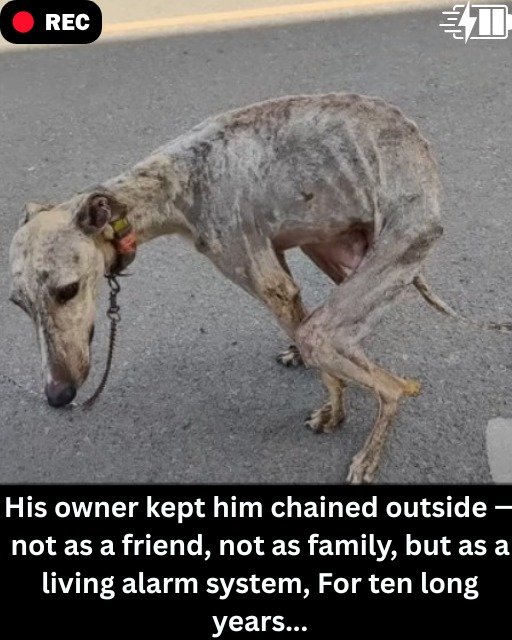
His name was Kalou. Not that anyone used it much. To the people inside the trailer, he wasn’t a pet, wasn’t a companion, wasn’t family. He was a tool. A living alarm system. Something that made noise when strangers approached.
The chain around his neck was thick, heavy, rusted in places. It ran from his collar to the gate post, allowing him just enough movement to reach a few feet in either direction. Not enough to lie down comfortably. Not enough to escape the sun or rain or snow. Just enough to exist.
For ten years, that was his life.
The Greyhound Who Never Ran
Kalou was a greyhound — a breed built for speed, for running, for feeling wind in their fur as they stretched out across open ground. Greyhounds are athletes, built to move.
Kalou hadn’t moved in a decade.
Oh, he paced sometimes. Back and forth, back and forth, the few feet his chain allowed. The ground beneath his paws had been worn bare by years of that pacing, a groove carved into the earth by his endless, futile patrol.
But mostly he stood. Stood at that gate, watching the road, watching the cars that passed without stopping, watching the world move on without him.
His body had long ago adapted to the chain. His neck had grown a permanent groove where the collar sat. His muscles had atrophied from years of limited movement. His coat, once sleek and beautiful, was matted and dull, marked by weather and neglect.
But it was his eyes that told the real story.
They were the eyes of someone who had given up waiting. Not sad, exactly. Just… empty. Resigned. Accepting that this was all there would ever be.
The Ten Winters
Ten Ohio winters passed while Kalou stood at that gate.
He learned what cold really meant — the kind that seeps into bones and never leaves. He learned that snow doesn’t care if you have shelter. He learned that ice forms on your fur and doesn’t melt until the sun remembers you exist.
He learned that no one comes to check on you when the temperature drops below zero.
Ten summers passed too. The kind of heat that makes the air shimmer, that bakes the ground until it’s too hot to lie on. Kalou learned to stand in the small patch of shade cast by the gate post, shifting as the sun moved, maximizing every inch of relief.
He learned that thirst is worse than hunger. That water bowls get knocked over and don’t get refilled. That no one notices when you haven’t drunk in two days.
Ten years of seasons. Ten years of weather. Ten years of standing at a gate, waiting for something to change.
The Neighbor Who Finally Looked
Her name was Maria, and she’d driven past that property every day for seven years.
She worked at a clinic in Columbus, took this road because it was shorter than the highway. Every morning and every evening, she passed that gate. Every morning and every evening, she saw that dog.
At first, she didn’t think much of it. Farm dogs live outside. Some dogs are tied up. It’s not her business.
But somewhere around year four of her commute, she started noticing details. The way the dog never moved from that spot. The way his ribs became more visible in winter, less visible in summer, but never quite healthy. The way he watched her car pass with those empty, hopeless eyes.
She started slowing down. Started looking longer. Started feeling something she couldn’t name.
Then one day, she saw something that made her pull over.
The Rain
It was November, cold rain falling in sheets, the kind of rain that soaks through everything and makes the world feel wet and miserable. Maria was driving home, wipers on full speed, when she passed the gate.
Kalou was there. Of course he was. He was always there.
But this time, he wasn’t standing. He was lying down — as much as the chain allowed — curled into a tight ball, trying to make himself as small as possible against the rain. His body shook with cold. His eyes were closed.
Maria pulled over.
She sat in her car for a long moment, rain pounding on the roof, staring at that dog. Then she got out.
The Approach
Maria walked toward the gate slowly, not wanting to startle him. The rain soaked through her jacket immediately, but she didn’t care.
Kalou heard her coming. His ears lifted. His eyes opened. He watched her approach with an expression she would never forget — not fear, not hope, just… wariness. The wariness of something that had learned that humans only bring pain.
“Hey, buddy,” Maria said softly. “Hey. It’s okay.”
She stopped a few feet away, letting him see her, letting him decide. Rain streamed down both of them, but neither moved.
Then Kalou did something that broke Maria completely.
He wagged his tail.
Just once. Just a small movement. But unmistakable. After ten years of standing at that gate, after ten years of being a tool instead of a living being, someone had stopped. Someone had seen him. And his tail remembered what it was for.
The Decision
Maria didn’t go home that night. She went to the county animal control office, then to the sheriff’s department, then back to her car, where she sat and cried.
The next morning, she made calls. Dozens of them. She called rescues, shelters, legal aid, anyone who might help.
A week later, she got a call from an organization called Greyhound Rescue of Ohio. They’d heard about Kalou. They wanted to help.
Together, they built a case. Documented his condition. Documented the chain, the lack of shelter, the years of neglect. They presented it to the authorities.
Two weeks later, they got a warrant.
The Rescue
The day they came for Kalou was cold but clear, winter sun struggling through clouds. Maria was there. So were two animal control officers and a volunteer from the rescue.
The owner came out of the trailer, angry, defensive. “He’s my dog. He’s fine. He’s always been fine.”
The officer showed the warrant. The owner argued, threatened, finally backed down.
Maria walked to the gate.
Kalou was standing in his usual spot, watching the commotion with those empty eyes. He didn’t know what was happening. He didn’t understand that everything was about to change.
Maria knelt beside him. “Hey, sweet boy. It’s time to go.”
She unclipped the chain.
For a moment, Kalou didn’t move. He stood there, confused, not understanding what had just happened. The weight was gone from his neck, but he didn’t know what to do without it.
Then Maria held out her hand. “Come on. Let’s go.”
Kalou looked at her. Looked at the open gate — the gate he had guarded for ten years but never passed through. Looked at the world beyond.
He took a step. Then another.
And for the first time in a decade, Kalou walked through that gate.
The First Ride
In the car, Kalou sat in the back seat, trembling. He had never been in a vehicle before. The movement, the sounds, the world rushing past the windows — it was overwhelming.
But Maria sat in the back with him, her hand on his back, her voice soft and steady. “You’re okay. You’re safe. You’re never going back there.”
Kalou pressed against her, still trembling, but gradually, slowly, relaxing. By the time they reached the rescue, he had laid his head in her lap and closed his eyes.
The Healing
The vet examined Kalou thoroughly. The findings were extensive — muscle atrophy, joint damage, dental disease, a heartworm infection that had gone untreated for years, scars around his neck where the chain had rubbed raw.
But his heart was strong. His spirit, buried deep, was intact.
The rescue named him Kalou — kept his name because it was his, because he deserved to keep something from those ten years. But they added something: Lucky. Kalou Lucky.
The first week in foster care was hard. Kalou didn’t know how to be a dog. He didn’t understand soft beds or regular meals or gentle hands that touched without hurting. He stood in corners, watching doors, waiting for something bad to happen.
His foster mom, Patricia, was patient. She showed him how to lie on a couch. How to accept belly rubs. How to trust that food would come again tomorrow.
On day ten, Kalou did something that made Patricia cry.
He picked up a toy. Just a simple stuffed toy, left on the floor. He carried it to his bed, lay down with it between his paws, and closed his eyes.
A dog who had spent ten years as an alarm system, who had never known comfort or love, had just claimed something as his own.
The First Run
Three months into his new life, Patricia took Kalou to a fenced field — the first open space he’d ever experienced.
She unclipped his leash. Kalou stood still, confused, not understanding what was expected.
Then Patricia ran.
Just a few steps, calling his name, encouraging him to follow. Kalou watched her, head tilted. Then something clicked. A memory, maybe, buried deep in his greyhound DNA. A knowledge of what his body was made for.
He ran.
Not fast at first — his muscles were still weak, still learning. But he ran. Across the field, his legs stretching, his ears flying, his whole body expressing something he had never felt before.
Freedom.
Patricia filmed it. Later, when she watched the video, she cried for an hour. A dog who had spent ten years on a chain, running free for the first time in his life.
The Forever Home
Kalou was adopted by a family in Cincinnati — a couple with a fenced yard and another rescued greyhound named June. They’d followed his story from the beginning. They’d cried over his photos. They’d waited months for him to be ready.
The first meeting was careful. Kalou was still shy, still uncertain. But June approached him slowly, sniffed him gently, then lay down beside him. Dog language for you’re okay, I’m here.
Kalou looked at June. Looked at the family. Looked at the yard full of sunshine and grass and freedom.
Then he wagged his tail. A real wag. Full and happy and unmistakable.
The adoption was finalized that day.
The Update
Last month, Patricia received a photo.
Kalou — now two years into his new life — was lying on a couch. Not near a couch. On a couch. His head rested on a pillow. His legs were stretched out in complete relaxation. Beside him, June was doing the same thing.
The caption read: “He still watches the gate sometimes. But now he watches it from inside, through a window, warm and safe. He runs every day in the yard. He sleeps on this couch every night. He is loved. Thank you for not leaving him at that gate.”
Patricia printed that photo. It went on her refrigerator, right next to her kids’ school pictures.
The Question We Must Answer
Kalou’s story has a happy ending because one neighbor finally looked. One woman pulled over in the rain. One rescue organization fought for him. One foster mom showed him love. One family said yes.
But for every Kalou, there are hundreds more still chained to gates, still standing guard, still waiting for someone to notice.
Here’s what you can do:
-
Share Kalou’s story. Share it so that someone, somewhere, looks twice at the dog they pass every day.
-
Know the laws. Many states have laws against prolonged tethering. Use them.
-
Support rescue organizations in your area. They’re the ones who answer the calls, who get the warrants, who never stop fighting.
-
Consider fostering. Kalou needed time to learn what love felt like. Foster homes make that possible.
-
Visit our website for more rescue stories. Every story is a reminder that no dog should live on a chain.
Kalou is home now. He runs in fields. He sleeps on couches. He knows what love feels like.
But somewhere, right now, another dog is standing at a gate, watching the road, waiting for someone to stop.
Be the one who does.