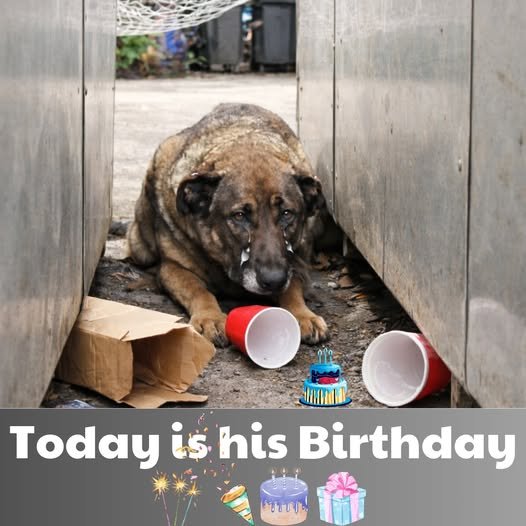
The Worst Birthday Anyone Ever Had
Nobody put a candle out for him.
Nobody baked anything, or tied a balloon to a fence post, or said his name with the particular warmth people use when they’re celebrating something. Nobody knew it was his birthday at all — including him.
What he knew was this: he was cold, he was hungry, and the gap between these two walls was the safest place he had found in longer than anyone could calculate.
He was a big dog — a German Shepherd mix with a brindle coat that might have been beautiful once, before the streets had their way with it. He had the bone structure of an animal built for loyalty and work and partnership. He had the eyes of a dog who understood more than people gave him credit for.
Those eyes were wet when the rescue volunteer found him.
His name, given to him later that day by the woman who pulled him from that alley, was Ranger.
And the day they found him — the day everything changed — happened to be the day the rescue organization’s records would later list as his estimated birthday.
He turned three years old wedged between two walls in a Memphis alley, crying, alone.
It was the last birthday he would ever spend that way.
How He Got to That Alley
Nobody knows the full story.
That’s the truth of street dogs — their histories are written in the condition of their bodies, in behavioral patterns that suggest things without confirming them, in the particular way they flinch or don’t flinch when a hand moves toward them.
What Ranger’s body said was this: he had been on his own for a long time. Long enough for his ribs to begin showing through his coat. Long enough for the pads of his feet to harden and crack from walking on asphalt with no rest. Long enough for his eyes to develop that specific quality — not wild, not aggressive, but deeply, quietly exhausted — that appears in animals who have been surviving rather than living for too long.
He had probably belonged to someone once. The way he responded to a calm voice suggested some early training, some period in his life when a human had invested enough time in him to teach him the basics. Sit. Stay. Come.
Someone had taken the time to teach him those things.
And then, somewhere along the way, that person had stopped.
Whether it was a move, a financial crisis, a life that changed faster than anyone planned — the reason didn’t matter to Ranger. What mattered was that the warmth had ended, and the streets had begun, and the gap between those two walls in Memphis was the closest thing to shelter he had found.
The Morning of His Birthday
The rescue volunteer’s name was DeShawn.
He was twenty-nine years old and had been doing street outreach for a Memphis-based animal rescue organization for two years. He drove the same neighborhoods every Tuesday and Thursday morning, moving slowly, watching for shapes in alleys and under dumpsters and behind the buildings where animals sometimes found corners to disappear into.
He had learned to look for stillness. Frightened animals go still. Suffering animals go still. An animal trying not to be seen holds itself in a particular way that, once you know what you’re looking for, becomes visible even at a distance.
That Tuesday morning in October, he saw it.
The gap between the two buildings was narrow — barely enough for a person to squeeze through sideways. But a dog, angled just right, could fit. And Ranger had learned that narrow spaces meant safety, meant that whatever was coming at you could only come from one direction at a time.
DeShawn parked the truck and sat for a moment.
He could see the dog clearly from the sidewalk. The brindle coat. The lowered head. The front paws extended on the concrete with an empty plastic cup knocked over beside them. And the eyes — looking directly at him with that exhausted, complicated gaze that asked something DeShawn had learned, over two years of this work, to recognize.
Are you going to hurt me or help me? Because I don’t have the energy to guess anymore.
DeShawn reached into the back of his truck for the soft lead and the bag of food he always carried.
He sat down on the sidewalk.
He opened the bag.
He waited.
The Eleven Minutes
It took eleven minutes.
DeShawn timed it later, not because it mattered, but because he wanted to remember it accurately — the specific duration of the moment when a dog decides, after everything, to trust again.
For the first few minutes, Ranger didn’t move. He watched DeShawn from the gap with those wet, careful eyes. He was taking in information — scent, posture, the quality of stillness that DeShawn had trained himself to project in these moments. Not aggressive stillness. Not the stillness of someone waiting to act. The stillness of someone who has genuinely stopped demanding anything.
At minute four, Ranger’s nose moved. Almost imperceptibly. Testing the air.
At minute seven, he shifted his weight forward. Just slightly. Just enough to indicate that the calculation was changing.
At minute nine, he took one step out of the gap.
At minute eleven, he was close enough for DeShawn to let him sniff his hand.
Ranger stood there for a long moment with his nose pressed against DeShawn’s fingers.
Then he leaned.
Just slightly — the way dogs lean when they have made a decision they’re not ready to announce yet, but the body has already committed to.
DeShawn put a gentle hand on his side and felt every rib.
He looked up at the sky for a second.
Then he clipped the lead, stood up slowly, and said: “Okay, buddy. Let’s go.”
What the Vet Found
The examination that afternoon confirmed what DeShawn’s hands had already told him.
Malnourished — significant muscle loss, weight nearly thirty percent below healthy range for his size and age. Dehydrated. Multiple untreated cuts on his paws. A healed fracture in his left rear leg that had never been set, which meant it had healed imperfectly, which meant he had been walking on it wrong for however long it had been broken.
The vet estimated his age at approximately three years.
She noted it in his file.
DeShawn looked at the date.
He looked back at the file.
“That’s today,” he said.
The vet looked at him.
“Today’s his birthday.”
The room was quiet for a moment.
Then one of the technicians left and came back two minutes later with a cupcake from the break room — the kind with too much frosting that someone had brought in for a colleague’s birthday the week before and hadn’t finished. She set it on the examination table in front of Ranger.
He sniffed it.
He looked at DeShawn.
DeShawn nodded. “Go ahead.”
Ranger ate the entire thing in four seconds.
It was the first birthday he had ever been celebrated.
The Photo and What It Did
DeShawn had been documenting Ranger’s rescue throughout the day — photos taken quickly on his phone, the kind of raw documentation that rescue workers do automatically, habit and record-keeping and a sense that these moments matter.
That evening, back at the rescue facility while Ranger rested in a quiet foster room, DeShawn went through the photos. He found the one taken in the alley — Ranger in the gap between the walls, the empty cup beside him, the wet eyes looking directly at the camera.
He posted it with the caption: “Found him this morning, alone in a Memphis alley. The vet says today is his estimated birthday. He turned 3 years old on the street, with an empty cup and no one. His name is Ranger. He ate a cupcake tonight. He’s safe now. Please share.”
By the next morning it had been shared 34,000 times.
By the end of the week: 78,000.
The comments were extraordinary — the specific kind of viral response that happens when an image captures something true about loneliness and resilience and the particular cruelty of a birthday spent entirely alone. People tagged friends. People cried in their cars. People who had never donated to an animal rescue in their lives found the organization’s page and gave what they could.
And among hundreds of adoption inquiries, one family from Nashville stood out.
The Birthday He Almost Didn’t Have
The Morrison family had three children, a fenced yard, and a German Shepherd named Duke who had passed away eight months earlier.
They had told themselves they weren’t ready. The kids still missed Duke. The house still felt wrong in the way houses feel when a large, constant presence suddenly disappears from them.
Then their oldest daughter, fourteen, saw Ranger’s photo on her phone at 10pm on a school night.
She came downstairs and showed her parents without saying a word.
Her father looked at the photo for a long time.
Then he looked at his wife.
She was already nodding.
They drove to Memphis on a Saturday. All five of them, in the family SUV, with a new collar and a new leash and a dog bed in the back seat that the kids had picked out themselves.
Ranger was brought out to meet them in the rescue organization’s meet-and-greet yard. He walked out carefully, still slightly uncertain in the way recovering street dogs are — present but cautious, engaged but not fully committed.
The youngest child, seven years old, sat down cross-legged on the grass without being asked.
Ranger walked to her.
He put his head in her lap.
The adults standing around the perimeter of that yard — DeShawn, the rescue coordinator, the Morrison parents — none of them said anything for a while.
There was nothing to say that the moment wasn’t already saying.
Ranger’s Next Birthday
Ranger turned four years old on a Tuesday morning in October, one year after DeShawn found him in that alley.
The Morrison children had planned it for weeks.
There was a dog-safe cake from a bakery in Nashville that made them specifically. There were new toys, still in their packaging, arranged beside his food bowl. There was a banner — hand-painted by the two younger kids — hung between the kitchen doorway and the living room wall.
It said: HAPPY BIRTHDAY RANGER. WE ARE SO GLAD YOU WERE FOUND.
He ate the cake the same way he had eaten that first cupcake in the exam room — completely, without hesitation, with a focus that made everyone laugh.
Then he carried one of the new toys to the couch, turned three circles, and went to sleep surrounded by the five people who had claimed him.
He has not spent a single night alone since the day DeShawn sat down on a Memphis sidewalk and waited eleven minutes.
He will not spend another one.
Every Dog Deserves a Birthday
Right now, somewhere in the United States, a dog is spending its birthday in an alley, or a shelter kennel, or the end of a chain in a yard where nobody comes.
They don’t know it’s their birthday. They don’t know what birthdays are. But they know warmth, and they know kindness, and they know the difference between a world that sees them and a world that doesn’t.
Ranger knows that difference better than most.
Here is what you can do:
🐾 Share this story — Ranger was found because someone was paying attention. Your share might help someone else pay attention today. 🐾 Support street animal rescue — organizations like the one that found Ranger run on donations and volunteers. They need both. 🐾 Consider adopting a large dog — big dogs, especially shepherd mixes, are among the most overlooked animals in American shelters. 🐾 Visit our website for more stories — because every rescue has a birthday worth celebrating.
Ranger is on a couch in Nashville right now, one of five people’s dog, completely certain he is exactly where he belongs. Somewhere today, another dog is in an alley, waiting for someone to sit down and wait eleven minutes. Please share this. Be that person.