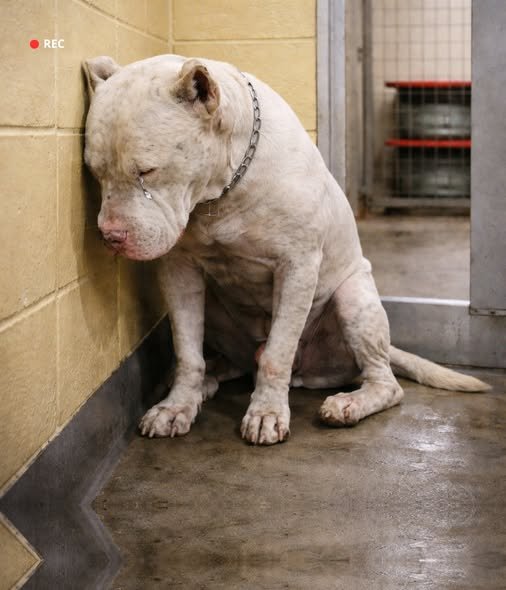
He Pressed His Face Into the Corner of the Shelter and Closed His Eyes — Staff Said They’d Never Seen a Dog So Completely Broken
A rescue dog story about the kind of surrender that happens before giving up completely — and the people who refused to let that be the ending.
The Corner
There is a posture that shelter workers learn to recognize.
It doesn’t announce itself. It doesn’t bark or pace or throw itself against the kennel door. It is the opposite of all of that — and in many ways, it is far more heartbreaking than any of those things.
It is a dog pressing himself into a corner and closing his eyes.
Not sleeping. Not resting. Just… closing the world out. Deciding, somewhere in the part of an animal that processes pain without language, that if he makes himself small enough, still enough, invisible enough — maybe the hurt will stop finding him.
His name was Ghost.
The shelter staff gave him that name not because he was pale and white, though he was — a large, broad-shouldered pit bull mix with a coat the color of old snow — but because of the way he existed in the building. Present but unreachable. There but somehow already gone.
Ghost had arrived at the municipal shelter in a mid-sized American city on a cold Tuesday morning in February. A cruelty surrender. The details of what had happened before were documented in a case file that the staff read once and did not discuss in the break room.
What they could see was this: a dog with visible mange across his face and body, patchy fur, a heavy chain collar, and a way of moving through the intake process — vaccinations, microchip, photographs — that was utterly, unnervingly silent.
He didn’t resist. He didn’t react. He walked where they led him, stood where they placed him, and when they opened the door to his kennel, he walked inside and went directly to the far corner.
He pressed his face into the place where the two walls met.
He closed his eyes.
And for the next several days, that is where he stayed.
What the Kennel Card Said — And What It Missed
In shelters across the United States, kennel cards are the first thing potential adopters read. They are meant to be brief — a snapshot. Name, age, breed, a few behavioral notes.
Ghost’s kennel card was not doing him any favors.
“Fearful. Slow to engage. Not recommended for homes with children or other animals. Requires experienced handler.”
Every word was accurate. None of them told the truth.
They didn’t mention that Ghost’s fear was not aggression — it had never once translated into a growl or a snap, not through intake, not through veterinary treatment, not through anything. They didn’t mention that “slow to engage” meant he needed approximately forty-five minutes of quiet, patient, non-demanding presence before he would lift his head. They didn’t mention that when he finally did lift his head — when the conditions were right and the person beside him had sat still long enough and hadn’t asked anything of him — he would turn and make eye contact with an intensity that made people catch their breath.
They didn’t mention that when he looked at you like that, it felt like being trusted with something extraordinarily fragile.
What the kennel card communicated to families walking the adoption corridor was simpler: keep moving.
And they did.
Weekend after weekend, families moved through the hallway. Dogs barked and spun and pressed eager noses to the gates. Tails wagged. Children pointed. Connections were made, leashes were clipped, new beginnings walked out the front door.
Ghost’s corner remained occupied.
The Weight of Being Overlooked
There is research — real, peer-reviewed research from animal behaviorists at universities across the country — that documents what prolonged shelter stays do to dogs. The stress hormone cortisol rises. Sleep becomes disrupted. Behaviors that were never present begin to emerge. Behaviors that were manageable intensify.
For dogs who arrive already carrying trauma, the shelter environment can accelerate a kind of unraveling.
Ghost was unraveling slowly, quietly, in his corner.
The skin condition across his face — already present at intake — worsened without the consistent treatment that an overwhelmed shelter system struggled to provide at the frequency he needed. The patchy fur. The irritated, reddened skin around his muzzle. Each week, the veterinary notes recorded incremental decline.
He was still eating. That was the one thing the staff held onto.
Every morning, his bowl was empty. Whatever Ghost had decided about the world, about people, about the future — he had not decided to stop eating. And the lead vet on his case said that meant something.
“A dog who has truly given up stops eating,” she told a volunteer coordinator during a weekly check-in. “Ghost is still eating. Something in him is still deciding.”
That something needed to be reached before the shelter’s capacity limitations made the decision for everyone.
Ghost’s name had not yet appeared on any list. But the staff knew how these things went. Space was finite. Time was not neutral.
The Volunteer Who Sat on the Floor
Her name was Patricia. She was sixty-three years old, recently retired from thirty years as a special education teacher, and she had started volunteering at the shelter because, as she told the coordinator during her orientation, she was good at waiting.
“I spent thirty years with kids who needed someone to sit with them and not expect anything,” she said. “I think I can do that for dogs.”
She was assigned to socialization work with the harder cases.
The first time she sat outside Ghost’s kennel, she brought a book. She sat in a folding chair, angled slightly away from him — not ignoring him, but not staring either — and she read. For forty-five minutes she sat there. Ghost did not move from his corner.
She came back the next day. And the day after that.
On the fifth day, twenty minutes in, she heard a sound — the soft shift of paws on concrete. She kept her eyes on her book.
Ghost had moved two feet from the corner.
He was looking at the back of her head.
Patricia turned one page. She did not look up.
On the eighth day, Ghost walked to the kennel gate and lay down six inches from where Patricia was sitting.
She reached two fingers through the gate. She did not push further.
He sniffed them. Deliberate, slow, thorough.
Then he rested his chin on the concrete floor and exhaled — the long, shuddering exhale of an animal releasing something it had been holding for a very long time.
Patricia closed her book. She pressed her fingers gently against the gate.
“I’ve got you,” she said quietly. “Take all the time you need.”
The Turn: When Ghost Decided to Try
Patricia flagged the behavioral team after the second week. She had documentation — careful, dated notes she had been keeping in a small notebook — of every incremental shift. Where Ghost positioned himself each day. When he made eye contact. When he accepted proximity.
The behaviorist who reviewed her notes said it was some of the most useful observational data she had received from a volunteer.
A formal behavioral reassessment was scheduled. This time, the evaluator sat on the floor. This time, there was no checklist being completed visibly, no clipboard held at chest height, no standing-over. Just a person, at Ghost’s level, being patient.
Ghost’s kennel card was rewritten.
“Highly sensitive dog requiring trust-based approach. Responds strongly to calm, experienced handlers. Demonstrates deep loyalty once bonded. Recommended for quiet adult home with patient adopter.”
The shelter coordinator posted a new profile online — new photos taken by a volunteer photographer who had spent an hour on the floor of the corridor waiting for Ghost to offer his face to the camera.
He did, eventually. And the photo she captured — Ghost making direct, steady eye contact, something in his expression that could only be called deciding — reached forty thousand people by the following morning.
The Adopter: Someone Who Recognized the Look
Marcus was a forty-seven-year-old Army veteran living outside of Raleigh, North Carolina. He had struggled with his own re-entry — his own version of pressing into corners and closing his eyes on the world. He had done the work, found the support, built his way back. He had been thinking about a dog for a year.
When he saw Ghost’s photo, he read the profile three times.
Then he called.
“I know what it looks like when someone needs people to stop expecting things from them for a little while,” he told the coordinator. “I’ve been that person. I think I know how to do this.”
Marcus made the drive on a Saturday. He sat on the floor of the meet-and-greet room and waited.
Ghost came to him in eleven minutes.
Marcus didn’t move. He let Ghost circle him, sniff him, assess him with that careful, thorough attention.
Then Ghost sat down next to him. Not in front of him. Next to him. Shoulder to shoulder, facing the same direction.
Marcus put one hand gently on Ghost’s back.
Neither of them moved for a long time.
The shelter staff watching through the window said it was the quietest adoption they had ever witnessed. And somehow the most complete.
Ghost Today: A Dog Who Came Out of the Corner
Ghost has been in Raleigh for four months.
He has a yard he patrols each morning with a seriousness that makes Marcus laugh. He has a dog bed he initially refused and now guards with proprietary intensity. He has learned that the sound of Marcus’s alarm means the day is starting and he should relocate from the floor to the bed before being invited — a maneuver Marcus pretended not to notice until he couldn’t keep a straight face.
The mange has been treated. His coat is growing back — white and full and, in the afternoon light of a North Carolina yard, almost luminous.
He still doesn’t love strangers. He probably never will entirely. But Marcus isn’t asking him to. What he’s asking is small: be here. Be safe. Be whatever you actually are.
Ghost, it turns out, is a great deal.
He is loyal with a completeness that takes Marcus’s breath away sometimes. He is perceptive — he knows, without being told, when Marcus is having a hard day, and on those days he stays closer. He is, in the quiet language of a dog who survived by closing his eyes to the world and then found one person worth opening them for — he is extraordinary.
Patricia still volunteers at the shelter. She has a photo on her refrigerator: Ghost and Marcus in the backyard, both of them looking at the camera, both of them squinting a little in the sun.
She keeps it there to remember what patience looks like when it arrives somewhere.
H3: The Dogs Still Facing the Wall
Right now, in shelters across America, there are dogs in corners. Dogs whose kennel cards say difficult when they mean hurt. Dogs who have closed their eyes not because they’ve given up entirely but because no one has sat still long enough to find out what’s left.
They need Patricias. They need Marcuses. They need people who understand that trust is not a performance — it’s a practice, and it takes as long as it takes.
Share Ghost’s story — because the person who needs to read it might be the one who changes everything for a dog just like him.
Visit our website for more rescue dog stories that will challenge you, move you, and remind you what people and animals are capable of together. Support your local shelter. Consider fostering. And if you have ever been someone who needed a little extra time before you could open your eyes again —
You might be exactly who a dog like Ghost is waiting for.
Some stories don’t start with a wag. Some start with a corner, and a closed door, and one person who decides to sit down and wait.
Those are often the best ones.