She Gave Birth and Was Immediately Abandoned: The Heartbreaking Shelter Story of a Mama Dog and Her 10 Newborns
Look at her face.
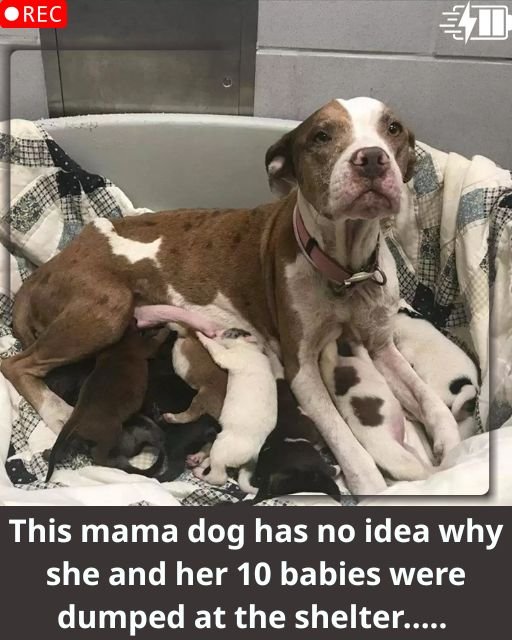
Not at the puppies piled against her belly, not at the shelter kennel walls surrounding her, not at the worn blanket beneath her exhausted body. Look at her face.
She’s staring directly into the camera with an expression that no dog should ever have to wear — a look of complete, quiet confusion. The kind of look that asks a question she has no language for: Why am I here? What happened to my home? What did I do wrong?
The answer, as far as anyone can tell, is nothing. She did absolutely nothing wrong.
She gave birth. She fed her babies. She did every single thing a mother is supposed to do. And somewhere between the delivery and the recovery — in those raw, depleted, impossibly vulnerable first days of motherhood — the people she had trusted with her entire life put her in a car, drove to the shelter, and left her there.
With ten newborns.
Still nursing.
This is her story. And it’s one that deserves to be told.
The Day They Arrived
Shelter staff have seen a lot. The nature of the job demands a kind of emotional armor that most people couldn’t sustain long-term. But when this mama dog came through the doors — gaunt, postpartum, a writhing pile of newborn puppies clustered against her — even seasoned workers stopped what they were doing.
She was wearing a pink collar. That detail matters more than it might seem. She wasn’t a stray. She wasn’t lost. She was owned, named, presumably loved at some point. Someone had chosen that collar for her, slipped it over her head, perhaps even scratched behind her ears while doing so.
And then they gave her up at the moment she needed stability, safety, and consistency most.
The staff logged the intake: one adult female pit bull mix, approximately two to three years old. Ten puppies, newborn, all apparently healthy. Surrendered by owner.
Reason given: unknown.
Why Pit Bull Mamas Are Among the Most at Risk
Here’s a truth that doesn’t get said loudly enough: pit bulls and pit bull mixes make up the largest percentage of dogs in American shelters. They stay longer. They are euthanized at higher rates. And when you add a litter of ten nursing puppies to the equation, the logistics for an underfunded shelter become genuinely overwhelming.
Space is finite. Resources are finite. Staff hours are finite. Ten puppies need round-the-clock monitoring in their earliest weeks — warmth regulation, weight tracking, nursing support. A postpartum mother needs nutritional support, veterinary oversight, and, critically, calm. Stress in a nursing mother affects milk supply, affects the puppies’ immune development, affects everything.
Dropping eleven dogs into a shelter environment all at once — with fluorescent lights, barking from adjacent kennels, unfamiliar smells, and strangers handling her babies — is not a neutral act. It has real consequences for everyone in that kennel.
The mama dog didn’t know any of that, of course. She just knew that something had shifted profoundly in her world, and she couldn’t explain it, and her babies were still hungry, and she was going to keep feeding them anyway because that’s what mothers do.
What Surrender Really Costs
Let’s talk honestly about pet surrender for a moment — not to shame the people who do it, because circumstances are complex and sometimes genuinely unavoidable — but to name what it actually is on the animal’s end.
Dogs do not have the cognitive architecture to understand shelter intake. They don’t know what a “temporary hold” is. They don’t understand that the person who left them is probably coming back someday, or isn’t, or had reasons. All they know is that their environment changed without warning, their person disappeared, and now there are strangers and sounds and smells and no explanation.
For a dog who just gave birth — whose hormones are surging with protective instinct, whose body is working overtime to sustain ten new lives — that level of abrupt destabilization is particularly brutal.
She kept looking toward the kennel door.
Shelter workers noticed. She kept watching it, between nursing sessions, as if expecting someone familiar to walk back through.
No one did.
The Community That Showed Up
Here’s where the story changes direction.
When the shelter shared the image — that surveillance-style photo of this mama dog staring into the camera with her pile of puppies — the response was immediate and overwhelming. The post spread across Facebook within hours, racking up shares from people who had never visited that city, never heard of that shelter, but could not scroll past that face.
Donation offers came in for food, supplies, and veterinary care. Foster applications flooded the inbox. Rescue organizations reached out to coordinate. People who had never done anything “activist” in their lives were suddenly making phone calls and filling out paperwork because something about this dog’s expression had reached through their screen and grabbed them.
That’s the power of a single image that captures something true.
Within days, a rescue network had stepped in. The mama and all ten puppies were transferred to a foster home — a quiet house, a real yard, someone who understood postpartum dog care and had the time and patience to provide it.
She stopped watching the door after a few days.
She started, cautiously, watching her new person instead.
What This Story Is Really About
Beneath the rescue narrative, this story is about something that applies far beyond animal welfare: what we owe to the vulnerable lives we bring into our responsibility.
When you adopt a pet, you make an implicit promise. Not a perfect promise — life changes, circumstances shift, and sometimes re-homing truly is the most humane choice. But a promise nonetheless. And when that promise is broken at the worst possible moment — at the point of maximum vulnerability — it leaves a mark. On the animal. On the people who witness it. On the system left to absorb the cost.
The practical lessons here are worth naming:
If you’re considering adding a dog to your family, think about the long-term picture, including the possibility of an unexpected litter. Spay and neuter conversations are not judgment — they’re planning.
If your circumstances change and you genuinely cannot keep your dog, please reach out to breed-specific rescues, foster networks, and veterinary social workers before a surrender becomes the only option. There is almost always a bridge solution that avoids a shelter drop.
If you see a shelter share a post like this one, know that sharing it is a meaningful act. Visibility saves lives. The right foster family or adopter might be one share away.
Where She Is Now
The mama dog — given the name Rosie by her foster family, a nod to that pink collar she came in wearing — is doing well. Her puppies are thriving, growing fast, and beginning to open their eyes to a world that, thanks to a chain of strangers who refused to scroll past her face, turned out to be far kinder than the one she briefly landed in.
She’ll be available for adoption once the puppies are weaned. So will they.
And somewhere out there is a home that doesn’t know yet that it needs her.
We hope she finds it. She has more than earned it. 🐾