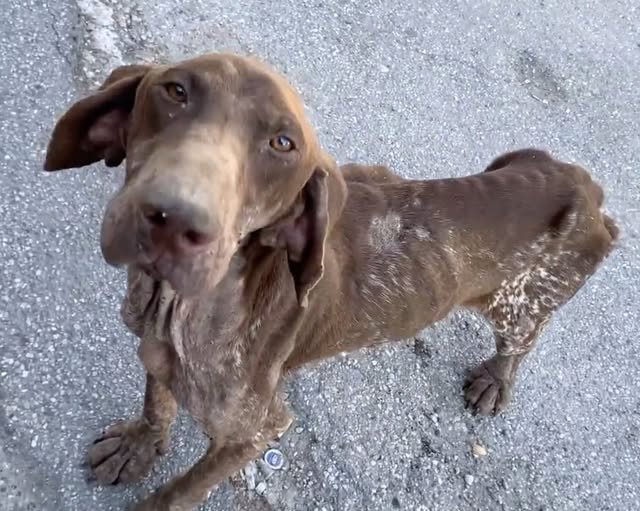
The world, for Charlie, was a landscape of sounds and smells and memories.
He couldn’t see the sun rising, but he could feel its warmth on his fur. He couldn’t see the faces of the people who walked past him, but he could hear their footsteps, could smell their fear or indifference or occasional pity. He couldn’t see the danger that surrounded him every day, but he could sense it in the tension of his own body, in the constant alertness that came from being vulnerable in a world that didn’t care.
Charlie was blind. Had been for a while, probably. The eyes that should have sparkled with life were clouded over, opaque windows to a soul that had learned to navigate without sight.
But blindness was only part of his problem.
His body was failing him too. He was thin—painfully thin—his ribs pressing against a dull, patchy coat. He had sores on his skin, the kind that come from diseases that eat away at a body from the inside. He was tired, so tired, the kind of bone-deep exhaustion that comes from fighting a battle you know you’re losing.
Charlie had leishmaniasis. A disease spread by sandflies, common in some parts of the world, devastating in its effects. It attacks the skin, the organs, the immune system. Without treatment, it is fatal. With treatment, it is long, expensive, and difficult.
And Charlie had been fighting it alone. Neglected. Forgotten. Abandoned by people who should have helped.
This is the story of how that dog—blind, sick, and broken—found his way back to love.
The Discovery
The rescue team got a call about a dog in an abandoned lot. “He’s not moving much,” the caller said. “I think he’s dying.”
When they arrived, they found Charlie exactly where the caller had described—curled in a patch of dirt, his body folded in on itself, his blind eyes facing the ground. He didn’t lift his head when they approached. He didn’t growl or bark or show any reaction at all. He had learned that reactions cost energy, and he had no energy to spare.
The rescuer, a woman named Isabel, knelt down slowly. She didn’t reach out immediately—she wanted him to know she was there, to hear her voice, to smell her before she touched him.
“Hey buddy,” she said softly. “Hey sweet boy. We’re here now.”
Charlie’s ears moved. Just slightly. He had heard her.
Isabel reached out and placed a gentle hand on his side. He was warm—that was something. He was alive—that was a miracle. But he was so thin, so fragile, so close to the edge that she could feel the line between life and death trembling beneath her fingers.
She looked at the team behind her. “We need to move fast. He doesn’t have much time.”
The Diagnosis
At the veterinary clinic, Charlie was examined thoroughly. The clouded eyes were examined first—irreversible damage, probably caused by a combination of neglect and disease. He would never see again. That part of his world was gone forever.
But the rest of him? The rest of him might be saved.
Blood tests confirmed what the skin sores suggested: leishmaniasis. Advanced, systemic, attacking his organs. The treatment would be long—months of medication, special diet, careful monitoring. It would be expensive. It would require commitment.
The team didn’t hesitate. Charlie had survived this long alone. He deserved a chance to survive with help.
Treatment began immediately. Medications to fight the parasite. Fluids to rehydrate. Nutritional support to rebuild his strength. And, perhaps most importantly, a warm, safe place to rest.
Charlie didn’t understand what was happening. He couldn’t see the people moving around him, couldn’t anticipate the needles and the medications. But he could feel the hands that touched him—gentle hands, careful hands, hands that didn’t hurt. He could hear the voices—soft voices, kind voices, voices that didn’t shout or curse. He could smell the absence of fear, the presence of something he had almost forgotten.
Safety.