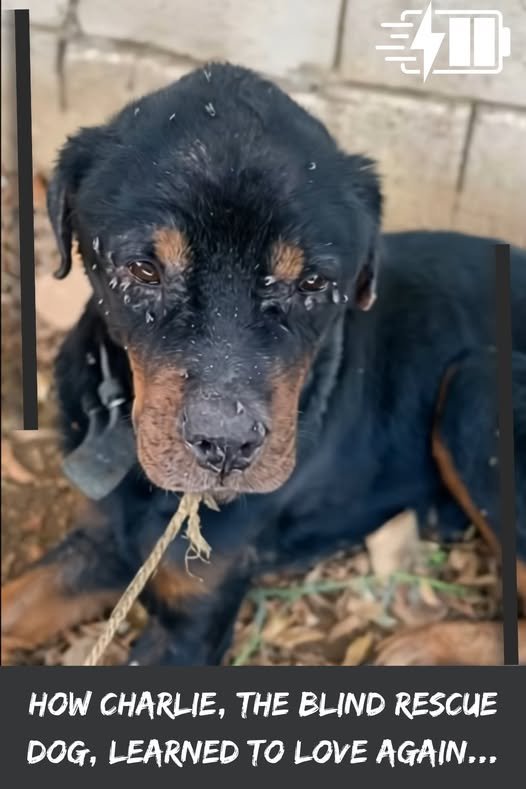
The world, for Charlie, was a landscape of sounds and smells and memories.
He couldn’t see the sun rising, but he could feel its warmth on his fur. He couldn’t see the faces of the people who walked past him, but he could hear their footsteps, could smell their fear or indifference or occasional pity. He couldn’t see the danger that surrounded him every day, but he could sense it in the tension of his own body, in the constant alertness that came from being vulnerable in a world that didn’t care.
Charlie was blind. Had been for a while, probably. The eyes that should have sparkled with life were clouded over, opaque windows to a soul that had learned to navigate without sight.
But blindness was only part of his problem.
His body was failing him too. He was thin—painfully thin—his ribs pressing against a dull, patchy coat. He had sores on his skin, the kind that come from diseases that eat away at a body from the inside. He was tired, so tired, the kind of bone-deep exhaustion that comes from fighting a battle you know you’re losing.
Charlie had leishmaniasis. A disease spread by sandflies, common in some parts of the world, devastating in its effects. It attacks the skin, the organs, the immune system. Without treatment, it is fatal. With treatment, it is long, expensive, and difficult.
And Charlie had been fighting it alone. Neglected. Forgotten. Abandoned by people who should have helped.
This is the story of how that dog—blind, sick, and broken—found his way back to love.
The Discovery
The rescue team got a call about a dog in an abandoned lot. “He’s not moving much,” the caller said. “I think he’s dying.”
When they arrived, they found Charlie exactly where the caller had described—curled in a patch of dirt, his body folded in on itself, his blind eyes facing the ground. He didn’t lift his head when they approached. He didn’t growl or bark or show any reaction at all. He had learned that reactions cost energy, and he had no energy to spare.
The rescuer, a woman named Isabel, knelt down slowly. She didn’t reach out immediately—she wanted him to know she was there, to hear her voice, to smell her before she touched him.
“Hey buddy,” she said softly. “Hey sweet boy. We’re here now.”
Charlie’s ears moved. Just slightly. He had heard her.
Isabel reached out and placed a gentle hand on his side. He was warm—that was something. He was alive—that was a miracle. But he was so thin, so fragile, so close to the edge that she could feel the line between life and death trembling beneath her fingers.
She looked at the team behind her. “We need to move fast. He doesn’t have much time.”
The Diagnosis
At the veterinary clinic, Charlie was examined thoroughly. The clouded eyes were examined first—irreversible damage, probably caused by a combination of neglect and disease. He would never see again. That part of his world was gone forever.
But the rest of him? The rest of him might be saved.
Blood tests confirmed what the skin sores suggested: leishmaniasis. Advanced, systemic, attacking his organs. The treatment would be long—months of medication, special diet, careful monitoring. It would be expensive. It would require commitment.
The team didn’t hesitate. Charlie had survived this long alone. He deserved a chance to survive with help.
Treatment began immediately. Medications to fight the parasite. Fluids to rehydrate. Nutritional support to rebuild his strength. And, perhaps most importantly, a warm, safe place to rest.
Charlie didn’t understand what was happening. He couldn’t see the people moving around him, couldn’t anticipate the needles and the medications. But he could feel the hands that touched him—gentle hands, careful hands, hands that didn’t hurt. He could hear the voices—soft voices, kind voices, voices that didn’t shout or curse. He could smell the absence of fear, the presence of something he had almost forgotten.
Safety.
The First Signs of Trust
The first week was touch-and-go. Charlie was so weak that he barely moved, barely ate, barely responded. The team would sit with him for hours, talking to him, letting him know they were there. He would listen—that much was clear. His ears would follow their voices, tracking them around the room.
But he didn’t engage. He didn’t seek contact. He accepted it when it came, but he didn’t ask for more. He had learned, in his long years of neglect, that asking was pointless. That wanting led to disappointment. That love was something that happened to other dogs.
Isabel understood this. She had seen it before—the emotional shutdown that comes from prolonged suffering. Charlie wasn’t just healing physically; he had to heal emotionally too. And emotional healing takes longer.
So she sat with him. Day after day. She would bring treats and hold them near his nose, letting him smell them before offering them. She would brush his matted fur, gently working out the tangles, talking to him the whole time. She would lay her hand on his side while he rested, letting him feel her presence even in sleep.
And slowly, almost imperceptibly, something began to shift.
The Breakthrough
It happened on a Tuesday afternoon, about three weeks into Charlie’s recovery.
Isabel was sitting beside him, as usual, reading aloud from a book she had brought—something about the ocean, about waves and beaches and endless blue. She didn’t know if Charlie understood the words, but she knew he liked the rhythm of her voice.
She reached down to scratch behind his ears, a gesture she had made hundreds of times before. And this time, something different happened.
Charlie turned his head. His blind eyes faced her direction. And then, slowly, hesitantly, he leaned into her touch. Just a little. Just a small shift of weight. But it was enough.
Isabel held her breath. She didn’t move, didn’t speak, didn’t want to break the spell. Charlie leaned a little more. His head rested against her hand. And for the first time since his rescue, he made a sound—a soft, almost inaudible sigh of contentment.
Isabel’s eyes filled with tears. She knew what this meant. Charlie had made a choice. He had decided, in that moment, that trust was worth the risk. That love was possible again.
The dog who had been blind, neglected, and fighting for his life had opened his heart.
The Long Road to Love
Learning to love again didn’t happen overnight for Charlie. There were setbacks—days when he retreated, days when the old fear returned, days when the weight of his past seemed too heavy to carry.
But there were also more breakthroughs. The first time he wagged his tail when Isabel walked into the room. The first time he sought her out, moving toward the sound of her voice instead of waiting for her to come to him. The first time he licked her hand, a tiny gesture of affection that spoke volumes.
The team celebrated each small victory. They understood that for Charlie, every step forward was a miracle. He had spent so long in darkness—literal and emotional—that learning to trust light took time.
Isabel became his person. Not officially—she was a volunteer, not an adopter. But Charlie didn’t understand official designations. He understood that when Isabel was there, the world felt safer. When Isabel spoke, the darkness felt less frightening. When Isabel touched him, he remembered what it felt like to be loved.
The Healing Power of Trust
As Charlie’s physical health improved, his emotional health blossomed. The leishmaniasis was brought under control with medication. His skin healed. His coat grew back soft and healthy. He gained weight, strength, energy.
But the real transformation was in his demeanor. The dog who had lain motionless in an abandoned lot, too tired to lift his head, now greeted visitors with a wagging tail. The dog who had accepted touch passively now sought it out, nudging hands with his nose, demanding attention. The dog who had forgotten how to love now loved openly, freely, without reservation.
He was still blind. That would never change. But blindness, he discovered, didn’t prevent love. It didn’t prevent joy. It didn’t prevent connection.
He learned to navigate the world through sound and smell and touch. He learned the layout of the rescue center, memorizing the paths to the yard, the food bowl, the favorite sunny spot by the window. He learned the voices of the volunteers, distinguishing Isabel’s from the others, recognizing her footsteps before she even entered the room.
And he learned to trust. Not cautiously, not conditionally, but fully. The way dogs trust when they know they are safe.
Lessons from Charlie’s Journey
Charlie’s story offers profound lessons about resilience, healing, and the nature of love.
1. Love Is Not Dependent on Sight:
Charlie couldn’t see the people who loved him, but he felt them. He heard them. He trusted them. Love is not a visual experience; it’s a felt one. We don’t need to see clearly to love deeply.
2. Healing Takes Time:
Charlie didn’t recover in a week or a month. His healing was gradual, incremental, sometimes two steps forward and one step back. Real healing—physical or emotional—cannot be rushed.
3. Trust Is a Choice:
Charlie chose to trust Isabel. He could have stayed closed, protected, isolated. But he made a choice to risk connection. Trust is always a choice, and it’s always a risk. But it’s the only path to love.
4. Past Trauma Doesn’t Define Future Joy:
Charlie had been neglected, abandoned, left to die. By any measure, he had every reason to be bitter, fearful, closed. But he wasn’t. He found joy again. His past didn’t determine his future.
5. Every Creature Deserves a Second Chance:
Charlie was blind, sick, and broken. Many would have called him a lost cause. But he wasn’t. He was a dog waiting for someone to see past his condition to his heart. Every creature deserves that chance.
A New Chapter
Today, Charlie lives in a forever home. Not with Isabel—she couldn’t adopt him, though it broke her heart. But with a family who understands his needs, who values his journey, who will never abandon him.
He has a bed by a window where he can feel the sun. He has regular meals, regular walks, regular love. He has people who talk to him constantly, knowing he can’t see them but trusting he can hear. He has a life—a full, rich, joyful life.
He still can’t see. But he doesn’t need to. He sees with his ears, his nose, his heart. He sees the people who love him in the way they touch him, the way they speak, the way they stay.
Charlie was blind, neglected, and fighting leishmaniasis when rescuers found him. But that’s not the end of his story. It’s just the beginning.
He learned to love again. And in doing so, he taught everyone around him what love really means.
If Charlie’s story moved you, don’t let it end here. Share it. Tell someone about the blind dog who found his way to love. Support organizations that rescue animals with complex medical needs. Consider adopting a special needs animal—they have so much to teach us about resilience and joy.
And next time you face darkness—literal or emotional—remember Charlie. Remember that blindness doesn’t prevent love. That healing is possible. That trust is worth the risk.
Because even in the darkest night, love finds a way.